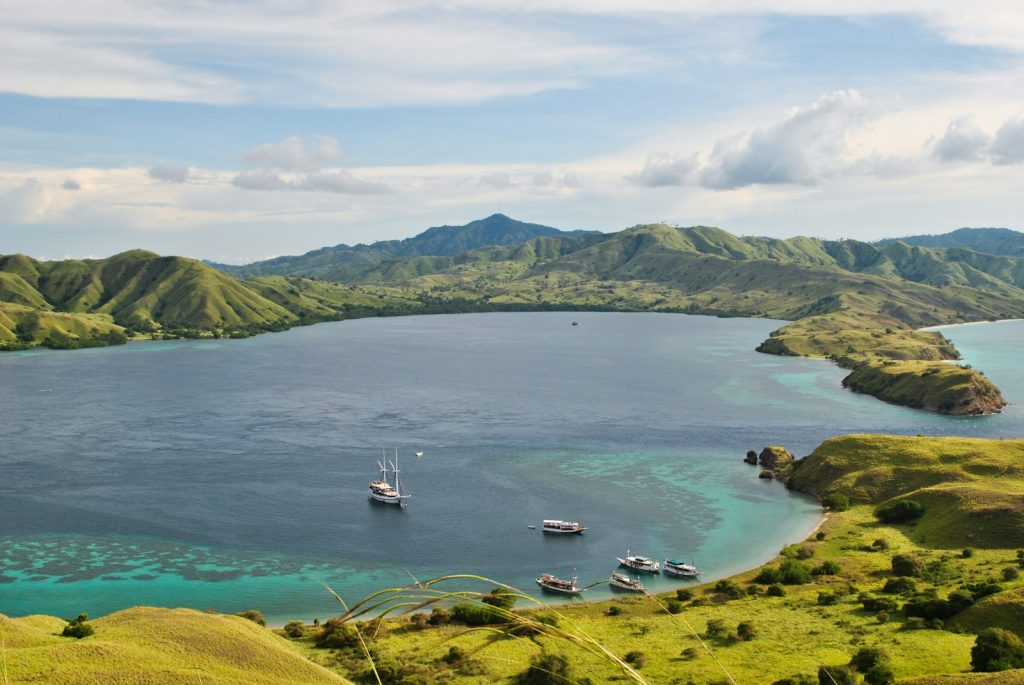
Parapuar is a state-managed integrated tourism development zone on the Bowosie forest hills directly above Labuan Bajo, Flores, Indonesia — gateway to Komodo National Park. To invest in Parapuar means entering a zone run by BPOLBF (Badan Pelaksana Otorita Labuan Bajo Flores), where the authority holds a Land Management Right (HPL) over approximately 129.6 hectares — a certificate handed over on 15 September 2023 — inside a larger planning footprint that has been publicly described as roughly 400 hectares.
In Manggarai, the name breaks down simply: para = door or gate, puar = forest. The zone’s own promotional materials render that as “gateway to the forest.” As a practical matter, the site sits about five minutes from Komodo International Airport and about seven minutes from the Labuan Bajo waterfront — close enough to town that it does not feel remote, high enough on the hillside that it commands a 360-degree view over the bay.
What follows is the most granular independent English-language guide to the zone available. Every figure carries a source date. Regulations are cited by number. Single-source claims are flagged UNVERIFIED. Built infrastructure is never blurred with planned commitments.
What Exists on the Ground Right Now (Mid-2026)
This matters before anything else. Investment guides for Parapuar — government advertorials, translated wire copy, consultancy landing pages — routinely list zipline courses, cable cars, luge runs, wellness lodges, and a Dusit Thani hotel as if they are already operating. They are not.
Confirmed as built or in active use as of mid-2026:
- A short internal access road (widely described as approximately 1.5 km; cost, engineering specs, and formal completion date are not in any public PUPR record — UNVERIFIED details beyond the general description).
- A 360-degree lookout and open event space at two elevations: Natas Parapuar at 238 metres above sea level and Taman Parapuar at 184 metres above sea level. These are actively used — BPOLBF’s “Weekend at Parapuar” (WAP) event series runs here, including the PENTAS x WAP 2026 edition on 6 June 2026 which drew a documented 1,044 visitors.
- The HPL Zone 1 certificate itself — the legal instrument that makes the cooperation framework for investors possible.
- A groundbreaking ceremony for “Parapuar Park” on 8 August 2024. Whether construction of that park has since been completed is not confirmed in accessible sources.
Committed but not yet built (as of mid-2026):
- Dusit (Thailand) — a reported US$15 million hotel on Lot 1.6. Source: a single April 2025 report (windonesia.com, 29 April 2025) citing BPOLBF Acting Director Frans Teguh. Brand tier, key count, signing date, and groundbreaking are unconfirmed. Status described only as “in progress.” UNVERIFIED.
- PT Eigerindo Multi Produk Industri (Eiger) — a reported US$1.2 million store and coffee shop; construction commitment linked to October 2025 in the same single-source report. UNVERIFIED: timing language in the original source is internally inconsistent. No confirmed construction start.
- PT Terra SparX — wellness and agro-tourism cooperation with BPOLBF on Lots M and N, announced by the Ministry of Tourism. Investment value, term length, and current status: UNVERIFIED.
- BPOLBF’s Frans Teguh described “5 to 6 committed investors” in April 2025. Only Dusit, Eiger, and Terra SparX are named anywhere in public records. The identities of the remaining 2–3 are not published.
Total publicly reported committed investment: approximately US$16.2 million (Dusit US$15M plus Eiger US$1.2M), both single-source and UNVERIFIED at the figure level. The adventure facilities (elevated cycling, zipline, luge, cable car), the cultural campus, and the full lot buildout described in BPOLBF promotional materials have no confirmed construction start date beyond the Parapuar Park groundbreaking.
That candor is not a reason to dismiss the zone. It is the baseline from which any serious due diligence has to start.
Zone Facts and the Numbers That Need Care
The ~400 Hectare Planning Figure
BPOLBF and BKPM/Kementerian Investasi promotional materials consistently describe Parapuar as a roughly 400-hectare zone. That figure is used here as a planning figure, not a cadastrally confirmed boundary. No publicly accessible regulatory document — no Keputusan Menteri, no SK BPN — has been identified that formally demarcates “400 hectares” as the precise zone boundary. Four-zone breakdown estimates (Cultural ±114.73 ha, Leisure ±63.59 ha, Wildlife ±89.25 ha, Adventure ±132.43 ha, summing to approximately 400 ha) circulate from a single critical-essay source and are reproduced here as indicative only. Do not treat them as cadastral data.
HPL Zone 1: ≈129.6 Hectares (Not 129,609)
The figure that matters most legally is the HPL Zone 1 area: approximately 129.6 hectares. Indonesian convention writes this as “129,609 ha” (using a comma as the decimal separator), and Antara’s English-language wire service reproduced it literally as “129,609 hectares” — a 1,000-fold unit error that has propagated into secondary coverage. If you see “129,609 hectares” in an English source, it means 129.6 ha, not 1,296 square kilometres. The corrected figure is corroborated by windonesia.com (“about 129.6 ha”) and the Indonesian Wikipedia entry (“129.60 ha”, 20.05% planned utilization).
The HPL certificate for Zone 1 was issued on 12 September 2023 and formally handed over on 15 September 2023 at the Parapuar site by Deputy Minister ATR/BPN Raja Juli Antoni. The government has described the land status as “clean and clear” — meaning BPOLBF holds a valid HPL over Zone 1. Community land disputes (addressed separately in the Bowosie section) are a distinct, ongoing matter.
The 19-Lot Structure and Four Zones
BPOLBF offers investors access to 19 designated lots within its HPL land. These lots are distributed across four officially named zones:
- Cultural Zone (Zona Budaya)
- Heritage-anchored programming, community-facing activities, cultural performance and arts infrastructure.
- Leisure Zone (Zona Rekreasi)
- Relaxed tourism amenities, food and beverage, retail, mid-scale accommodation.
- Wildlife Zone (Zona Wild Nature)
- Nature immersion, forest experiences, wildlife-adjacent programming.
- Adventure Zone (Zona Petualangan)
- Active tourism formats: the planned zipline, elevated cycling, luge, and inclinator facilities described in BPOLBF promotional materials. All are planned, none confirmed as built.
BPOLBF’s stated development pledge is roughly 20% built utilization and 80% retained as green forest cover. Critics from civil-society organizations have noted that even a 20% built footprint plus supporting infrastructure can fragment habitat and affect the ecological integrity of the remaining “green” land — a nuance the pledge does not resolve.
Parapuar, Golo Mori, and Town Land: A Comparison
If you are evaluating where in the Labuan Bajo area to commit capital, three distinct land frameworks are in play. They are not interchangeable.
| Factor | Parapuar (BPOLBF HPL) | Golo Mori / Tana Mori (ITDC) | Labuan Bajo Town Land (Private) |
|---|---|---|---|
| Authority type | Ministry of Tourism authority body (BPOLBF) holding state HPL | BUMN estate developer (ITDC / InJourney Tourism Development Corp), PMN 2021 assignment | Private SHM or SHGB titles; individual owner transactions |
| Land size (core area) | ≈129.6 ha HPL Zone 1; planning figure ~400 ha total | ~20 ha developed; up to ~1,000 ha ambition (planning only — UNVERIFIED) | Individual parcel; no master-plan constraint |
| Investor land right | Cooperation agreement or HGB-on-HPL; exact instrument and term not publicly published — verify with BPOLBF | ITDC estate lease / development scheme; details not publicly confirmed for non-MICE lots | PT PMA can hold HGB (30+20+30 yrs under PP 18/2021); individuals via Hak Pakai with valid stay permit |
| KEK (tax-incentive zone) status | Not a KEK. No fiscal incentives specific to the zone. | Proposed/planned KEK — NOT yet established by Peraturan Pemerintah as of available records. Verify against current Dewan Nasional KEK list. | Not applicable |
| Lot pricing/tariff | No publicly published tariff; direct negotiation with BPOLBF | Not publicly published for private lots | Asking prices: hillside near town IDR 500K–2M/m²; sea-view IDR 2–15M/m² (UNVERIFIED broker data; no official index) |
| Anchor MICE infrastructure | None operational; adventure/cultural facilities planned only | Golo Mori Convention Center (GMCC) operational since April 2023; hosted 42nd ASEAN Summit May 2023 | Meruorah Convention Center (town waterfront, G20-era) |
| Confirmed branded openings | None as of mid-2026 | None confirmed at Golo Mori as of available 2025 data | AYANA Komodo (2018); Ta’aktana Luxury Collection / Marriott (2023); Meruorah; Sudamala; Plataran |
| Setting / positioning | Hillside forest above town; nature/culture/adventure; viewpoint over bay | Coastal headland ~25 km / ~45 min SE of town; MICE-anchored | Town, beach, or hillside — varies by parcel |
One structural note foreigners sometimes miss: in Parapuar, you never own land. Rights derive entirely from BPOLBF’s HPL via a cooperation arrangement. The land does not transfer; BPOLBF remains the HPL holder. This is fundamentally different from buying or long-leasing private SHM/HGB land in Labuan Bajo town, where the counterparty is a private land owner rather than a government authority body. Neither model is inherently superior — they carry different risk profiles, counterparty structures, and exit mechanics.
How Foreign and Domestic Investors Access Parapuar Lots
The BPOLBF Cooperation Framework
Because BPOLBF holds the HPL, investors do not purchase lots outright — they enter cooperation agreements with BPOLBF. Indonesian land law provides several instruments for this; the relevant categories include:
- HGB di atas HPL (right to build on land managed by another party) — standard for commercial hotel and resort development. Under PP 18/2021, HGB has a base term of 30 years, extendable by 20 years, and renewable for a further 30 years, though the actual term in BPOLBF’s cooperation documents for Parapuar has not been publicly disclosed. Do not rely on any specific term figure until confirmed directly with BPOLBF.
- KSPI / KETUPI and other cooperation schemes — BPOLBF’s FAQ referenced six formal cooperation types including Sewa Aset (asset lease), KSP (cooperation and utilization), BGS/BSG (build-operate-transfer variants), KSPI, and KETUPI. The precise instrument offered per lot is not standardized across available public materials.
No publicly published tariff schedule exists for Parapuar lot access. Engagement begins directly with BPOLBF’s investment and cooperation division, and through Kementerian Investasi/BKPM’s regional desk for NTT. No fee-bearing intermediary is part of the official pathway.
PT PMA and OSS-RBA Requirements
Foreign investment in Indonesian tourism facilities runs through a PT PMA (Penanaman Modal Asing) — a limited liability company with foreign capital. Standard requirements under current regulations (Peraturan BKPM No. 4/2021; UU 11/2020 Cipta Kerja; PP 5/2021):
- Minimum investment above IDR 10 billion (approximately USD 615,000 at mid-2026 rates), excluding land and buildings, per 5-digit KBLI code per project location.
- Minimum issued and paid-up capital of IDR 10 billion.
- Business licensing through OSS-RBA (Online Single Submission — Risk-Based Approach). Relevant KBLI codes include 55110 (star hotel accommodation) and sector-specific codes depending on facility type.
A PT PMA can hold HGB on land it develops, including HGB derived from the authority’s HPL. It cannot hold Hak Milik (freehold) — that title category is closed to any foreign-capitalized entity under UUPA UU 5/1960.
The market-entry chain — foreign brand or investor, PT PMA formation, OSS/KBLI licensing, BPOLBF cooperation agreement, HGB registration on HPL — is multi-step and involves both the investment ministry and the land ministry. Sequencing matters. If you want an introduction to independent legal specialists with direct experience in this chain, use our enquiry form — we make no representations about outcomes, only about the quality of the introductions.
Incentives Reality Check: What Parapuar Does — and Does Not — Offer
This is one of the most under-reported facts about the zone: Parapuar is not a KEK (Kawasan Ekonomi Khusus).
A Special Economic Zone designation under Indonesian law (PP 40/2021 and related regulations) triggers specific fiscal facilities — income tax reductions, VAT/luxury-tax exemptions, customs and excise relief, simplified land and licensing procedures. None of those automatic KEK facilities apply in Parapuar, because the zone does not carry KEK status. Any adviser or promotional material that implies “Parapuar KEK” incentives should be questioned directly.
General national incentives are technically available subject to eligibility screening, but they are not Parapuar-specific:
- Tax holiday (PMK 130/PMK.010/2020 framework): reserved for pioneer industries on the ministry’s designated list. Standard hotel and resort operations are generally not classified as pioneer industries. UNVERIFIED: the precise status of the tax-holiday program post-2025 is policy-sensitive; verify current PMK before any planning assumption.
- Tax allowance (PP 78/2019): eligibility depends on KBLI code and whether the project location appears in the relevant annexes. Must be verified case-by-case.
- Vocational training super deduction (PMK 128/2019) and R&D super deduction (PMK 153/2020): available to qualifying expenditure but require specific activity structures.
What BPOLBF and the government do offer is: land legality (a “clean and clear” HPL with a valid certificate), coordination across ministries (investment, land, environment, tourism), and a managed zone framework intended to reduce some of the individual permitting friction faced when developing outside a designated area. That is facilitation, not fiscal benefit. It is meaningful — but it is not a KEK.
Golo Mori’s KEK status is also unresolved: as of available records, Tana Mori is a proposed tourism KEK but has not been established by Peraturan Pemerintah, which is the required legal act. Verify against the current Dewan Nasional KEK list before assuming KEK facilities there either.
The Bowosie Forest: Land History, Community Claims, and Ongoing Disputes
Parapuar sits inside Hutan Bowosie (Nggorang Bowosie) — until the Perpres 32/2018 designation, this was a state production forest functioning as Labuan Bajo’s ecological buffer and part of its water catchment. The Wae Mese spring is the main named PDAM (municipal water utility) source for Labuan Bajo, a town that already faces chronic water scarcity — intermittent piped supply, significant reliance on trucked water. Critics from WALHI NTT and civil-society researchers have warned that deforestation and impervious-surface expansion in the Bowosie catchment worsens both recharge capacity and flood/landslide risk downstream.
The forest release process required a decree (SK) from KLHK (Ministry of Environment and Forestry), after which ATR/BPN processed the HPL certificate. The specific KLHK SK number and date have not been identified in any media, NGO, or regulatory database accessible during our research. That is a genuine documentation gap, not an oversight of ours. We state it openly.
Community Land Claims
Four kampung — Racang Buka, Kaper, Lancang, and Nggorang — hold customary and long-term occupancy claims to land within the Bowosie area. Residents have described cultivation and habitation dating to at least the 1990s, with some citing earlier periods. These are community accounts, not cadastral records.
The contestation was not passive. In 2022, residents physically blocked land-clearing machinery in the Parapuar area. Demonstrations occurred in Labuan Bajo through 2022–2023. Field organizations including Sunspirit for Justice and Peace, investigative outlet Floresa.co, WALHI NTT, and AMAN Nusa Bunga documented and publicized the confrontations. Letters to the President and petitions to Komnas HAM have been referenced by these organizations, though no formal Komnas HAM docket specific to Bowosie has been publicly confirmed.
BPOLBF proceeded with the HPL certificate in September 2023, groundbreaking in August 2024, and active investor promotion in 2025. As of mid-2026, no publicly documented comprehensive settlement, compensation scheme, or formal recognition of customary land rights in relation to the affected kampung has been recorded. The dispute is ongoing and structurally unresolved.
What This Means for Investors
It means the state’s “clean and clear” HPL certificate describes the legal title position from the Indonesian land registry’s perspective — it does not mean the underlying community disputes are settled. This is a risk factor that belongs in any due-diligence checklist. It is also context for understanding why BPOLBF emphasizes the 80% forest-retention pledge: the communication is partly addressed at an audience that includes critics and affected communities, not only at hotel investors.
Labuan Bajo: The Demand Thesis and What the Numbers Actually Say
The investment case for the Labuan Bajo area rests primarily on the destination’s designation as one of Indonesia’s five DPSP super-priority destinations (alongside Lake Toba, Borobudur, Mandalika, and Likupang) under the RPJMN 2020–2024 national development framework. That designation has driven disproportionate central-government infrastructure attention and international marketing spend relative to the destination’s historical visitor volumes.
Komodo National Park visitor data from Balai TN Komodo, cited in a 2025 academic paper, records growth from approximately 44,492 visitors in 2010 to 300,488 in 2023. Claims of a further jump to 429,509 in 2025 appear in some secondary sources but are single-source and UNVERIFIED — we do not use that figure as planning input.
Branded hotel supply is still limited. Operating properties include AYANA Komodo Waecicu Beach (since 2018), Ta’aktana, a Luxury Collection Resort & Spa (Marriott’s first hotel in Labuan Bajo, opened 2023), Meruorah Komodo, Sudamala Resort, and Plataran Komodo. Room supply totals and occupancy rates are not reliably available from open sources — any occupancy claims you encounter from consultancies or brokers should be treated as marketing estimates, not verified data.
The March 2026 announcement that Danantara Indonesia and Qatar Investment Authority (QIA) are partnering on a greenfield tourism project in Labuan Bajo (Pandu Sjahrir, CIO, 31 March 2026) confirms continued sovereign-level capital attention to the area. No project value was disclosed; site and operator details remain unannounced.
Airport access improved substantially with Komodo International Airport’s 25-year KPBU/PPP concession to a PT Cardig Aero Services and Changi Airports International consortium — Indonesia’s first brownfield airport PPP, with a runway of 2,450 metres and a design capacity reported at approximately 4 million passengers per year (UNVERIFIED: single-direction project documentation). International routes now include AirAsia service from Kuala Lumpur, launched around 2023. Infrastructure budget reductions at the national level in 2025 (new-build PUPR budget was materially cut) are a headwind for utility and road development across the country, including in NTT; Parapuar’s internal utility buildout should be verified per-lot with BPOLBF rather than assumed from headline capital commitments.
For those in the early stages of evaluating a Labuan Bajo position — whether at Parapuar, Golo Mori, or in the private land market — our enquiry form connects you with vetted independent specialists in PT PMA formation, land due diligence, and tourism licensing. We do not allocate lots, guarantee approvals, or promise returns. We make introductions to people who know the ground.
Navigate This Guide
Parapuar Investment Intelligence covers this zone in depth across dedicated pillar pages. Each section is grounded in the same standards as this one — sources dated, single-source claims flagged, built separated from planned.
- Zone Facts & HPL Structure — the 129.6 ha certificate, Zone 1 boundaries, the 400 ha planning figure, official zone naming, and what the numbers actually mean.
- 19-Lot Map & Committed Investors — the lot structure, zone assignments, Dusit Lot 1.6 (UNVERIFIED), Eiger, Terra SparX, and the gap between “5–6 investors” and what is named publicly.
- HPL Sublease Mechanics — how HGB-on-HPL works, the six cooperation schemes, tenure terms, PT PMA eligibility, and what an investor actually signs.
- PT PMA & OSS-RBA Market Entry — step-by-step from foreign entity to operating business on a Parapuar lot, KBLI codes, minimum capital, and sequencing.
- Incentives Reality Check — why Parapuar is not a KEK, what incentives do and do not apply, and how it compares with KEK-proposed Golo Mori.
- Bowosie Forest, Adat & Environment — the full land-history and community-dispute record, WALHI/Sunspirit findings, and what “clean and clear” title does and does not mean.
- Infrastructure Status Ledger — per-item: what is built, what is committed, what is planned-only, and the utility situation lot-by-lot.
- Parapuar vs Golo Mori vs Town Land — the comparison table in depth, risk profiles, exit mechanics, and counterparty differences.
Frequently Asked Questions
What exactly is Parapuar and who controls it?
Parapuar is a state-managed integrated tourism development zone on the Bowosie forest hills above Labuan Bajo, Flores, within the administrative area of Kecamatan Komodo, Kabupaten Manggarai Barat, NTT. It is controlled by BPOLBF — Badan Pelaksana Otorita Labuan Bajo Flores — a government authority body under the Ministry of Tourism, established by Perpres No. 32 of 2018. BPOLBF holds a Land Management Right (HPL) over approximately 129.6 hectares of Zone 1, with the certificate formally issued on 12 September 2023 and handed over on 15 September 2023. The total zone planning figure is described as roughly 400 hectares, though this has not been confirmed in a publicly accessible cadastral document.
Can foreigners invest in Parapuar, and what land rights do they get?
Yes, foreign capital can participate through a PT PMA (Indonesian foreign-investment company). A PT PMA can hold HGB (right to build) derived from BPOLBF’s HPL — this is called HGB di atas HPL. Foreigners cannot hold Hak Milik (freehold) anywhere in Indonesia under UUPA UU 5/1960. What a Parapuar investor actually holds is a derivative right from BPOLBF’s cooperation agreement, not independent ownership of the land. The exact term, renewal mechanics, and form of the cooperation document are not publicly published and must be verified directly with BPOLBF before any commitment.
Is the Dusit hotel at Parapuar open, and which investors have confirmed?
No. As of mid-2026, no hotel or commercial facility is open at Parapuar. Dusit’s reported US$15 million hotel on Lot 1.6 is described in a single April 2025 media report as “in progress” — no brand tier, key count, groundbreaking date, or further construction update has been publicly confirmed. That figure and lot assignment are UNVERIFIED. Eiger’s reported US$1.2 million store and coffee shop has a construction commitment described in the same single-source report linked to October 2025, also UNVERIFIED. BPOLBF’s Acting Director Frans Teguh described “5 to 6 committed investors” in April 2025; only Dusit, Eiger, and Terra SparX are named in accessible public records.
Does Parapuar have KEK (Special Economic Zone) tax incentives?
No. Parapuar is not a KEK. The fiscal incentives created under PP 40/2021 for Special Economic Zones — income-tax reductions, VAT exemptions, customs relief, and simplified licensing — do not apply in Parapuar. The zone offers a managed HPL framework and government coordination, but no Parapuar-specific fiscal incentive has been publicly established. Standard national incentives (tax allowance under PP 78/2019, certain super deductions) remain available subject to KBLI eligibility and case-by-case screening, but none of these are Parapuar-exclusive. For comparison, Golo Mori has been described as a proposed tourism KEK but has also not been formally established by Peraturan Pemerintah as of available records — verify both against the current Dewan Nasional KEK list.
What is the community and environmental controversy around Bowosie Forest?
Parapuar was carved from Hutan Bowosie (Nggorang Bowosie), a state production forest that served as Labuan Bajo’s ecological buffer and water catchment. Four kampung — Racang Buka, Kaper, Lancang, and Nggorang — hold customary and long-term occupancy claims to land within this area and have contested the project. In 2022, residents physically blocked land-clearing machinery. Field organizations including Sunspirit for Justice and Peace, Floresa.co, WALHI NTT, and AMAN Nusa Bunga have documented ongoing disputes. As of mid-2026, no comprehensive settlement, compensation, or formal recognition of customary land rights has been publicly recorded. BPOLBF holds a valid HPL certificate from the Indonesian land registry’s perspective, but the underlying community land claims are structurally unresolved. Environmental concerns center on catchment integrity, water supply for Labuan Bajo town, and the fragmentation effects of any development on a forest that provides ecological services beyond its boundary.