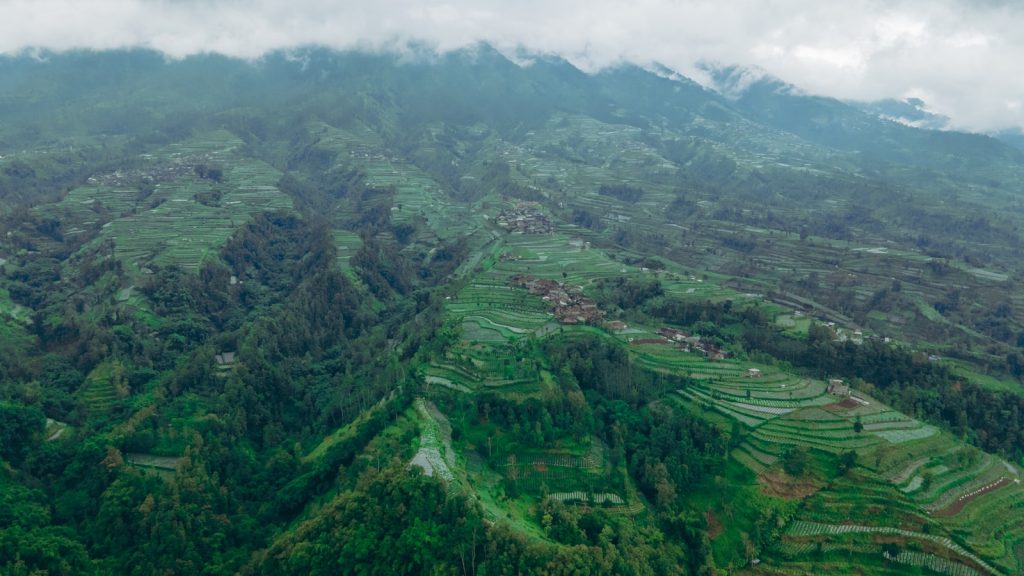
Parapuar infrastructure status as of mid-2026 is best described in three distinct categories: a short access road and a 360-degree viewpoint that demonstrably exist, a utility framework (water, electricity, telecommunications) that is being extended from the wider Labuan Bajo system with no lot-level documentation publicly available, and a roster of attractions — cable car, zipline, luge, amphitheater — that appear in BPOLBF promotional materials but have no confirmed construction schedule or budget in the public record. This page tracks each item in that order, flags every number with its source and date, and tells you what an investor or visitor needs to verify independently before drawing conclusions about readiness.
The zone itself sits on forested hills 5–7 minutes from Komodo International Airport and from the town marina, inside the former Nggorang Bowosie production forest. BPOLBF holds a Land Management Right (HPL) over Zone 1, covering approximately 129.6 ha — a figure the authority handed over formally on 15 September 2023. Beyond that certificate, the on-the-ground infrastructure picture is thin relative to what promotional coverage implies. The gap between the two is the whole story of this page.
Why a Three-Column Ledger Matters Here
No ranking source currently separates built from planned at Parapuar. Official press releases, Jakarta Post advertorials, and investor-facing BKPM materials describe the cable car and the access road in the same breath, giving the impression that both exist today. They do not. The access road is real. The cable car is a concept drawing.
For an investor conducting due diligence on one of the 19 lots BPOLBF offers on its HPL land, the distinction is financially significant. A lot whose approach road is built and whose viewpoint is operating is a different product from a lot whose nearest utility connection requires a capital works program that has no published timeline. Blurring the two is a disservice. This ledger does not blur them.
One important caveat: progress pembangunan parapuar moves faster than this page can be updated. Every row below carries a last-verified date. If that date is more than six months old, check with BPOLBF directly before relying on the status call.
The Infrastructure Status Ledger
The table below covers the main physical and utility categories. Each row identifies what is claimed, what is confirmed, and what remains unverified. Rows in the BUILT column have at least one named public source with a date. Rows in STAGED/IN PROGRESS reflect official statements about intent or partial completion. Rows in PLANNED/UNCONFIRMED rest on promotional materials only — no construction contract, PUPR procurement notice, or groundbreaking has been publicly documented.
| Category | Status | Detail & Source | Last Verified |
|---|---|---|---|
| Internal access road (~1.5 km) | BUILT | A short access road into the zone has been built. The ~1.5 km figure appears consistently in official speeches and media (Antara EN 315534; windonesia.com, Apr 2025). Cost, technical specs, and exact completion date are absent from public PUPR procurement records — these details remain unverified at source. | May 2025 |
| 360° viewpoint / event terrace | BUILT | The panoramic lookout is operational. BPOLBF has hosted its Weekend at Parapuar (WAP) event series here, including the PENTAS x WAP edition on 6 June 2026 that drew 1,044 visitors (antaranews.com/berita/5597608; sindonews). The viewpoint is the only confirmed public-facing infrastructure actively in use. | June 2026 |
| Parapuar Park (taman wisata) | GROUNDBREAKING HELD; COMPLETION UNVERIFIED | Groundbreaking for Parapuar Park was held on 8 August 2024 (Tempo EN 1898497). No public update on construction progress, completion date, or opening status has been located since that announcement. Do not treat the groundbreaking as an opening. | August 2024 |
| Water supply (PDAM / independent source) | STAGED — verify per lot with BPOLBF | No project-level public documentation of a dedicated water supply system inside Parapuar has been located. BPOLBF’s 2024 statements referenced water, electricity, and waste management as part of a staged infrastructure program tied to the wider Labuan Bajo system. The town itself draws from the Wae Mese spring via PDAM and already experiences chronic intermittent supply. Investors must confirm utility connectivity and pressure commitments directly with BPOLBF before lot negotiations. | 2024 (BPOLBF general statement) |
| Electricity (PLN grid connection) | STAGED — verify per lot with BPOLBF | As with water, BPOLBF has stated that electricity staging is part of the zone’s infrastructure rollout from the wider Labuan Bajo PLN network. No lot-specific load or connection date documentation is publicly available. PLN capacity in Labuan Bajo has historically been a constraint on development across the town — new resort-scale demand will require confirmed allocation, not just proximity to the grid. | 2024 (BPOLBF general statement) |
| Telecommunications / fibre | STAGED — verify per lot with BPOLBF | Telco coverage in the hills above Labuan Bajo is functional for mobile data at the viewpoint (confirmed by WAP event operations), but fibre or dedicated enterprise-grade connectivity for resort operations is unconfirmed at lot level. BPOLBF has not published a telco infrastructure plan for the zone. | June 2026 (inferred from event operations) |
| Wastewater / solid waste management | STAGED — no public documentation | BPOLBF has referenced waste management as part of staged utility development. No environmental permit (AMDAL or UKL-UPL) for zone-wide waste systems has appeared in accessible public records. This is a material due-diligence item for any resort or food-and-beverage operator. | 2024 (BPOLBF general statement) |
| Cable car / gondola | PLANNED / UNCONFIRMED | Appears in BPOLBF concept presentations and broker/advertorial descriptions of the Adventure Zone. No construction contract, safety certification process, operator tender, or PUPR project listing has been publicly identified. Do not present this as existing or imminent. | N/A — concept only |
| Zipline | PLANNED / UNCONFIRMED | Same status as cable car. Mentioned in adventure-zone concept materials. No confirmed operator, safety audit, or permitting process in the public record. | N/A — concept only |
| Luge track | PLANNED / UNCONFIRMED | Appears in adventure zone concept descriptions. Same evidentiary situation as cable car and zipline — promotional only, no construction documentation. | N/A — concept only |
| Creative hub / arts complex | PLANNED / UNCONFIRMED | Referenced in zone concept materials tied to the Cultural District. No design permit, contractor announcement, or physical site preparation has been documented in accessible records. | N/A — concept only |
| Amphitheater | PLANNED / UNCONFIRMED | Mentioned as a Cultural Zone facility. The existing event terrace at the viewpoint serves as a de facto outdoor venue (WAP events), but this is not a purpose-built amphitheater. No formal amphitheater construction has been announced with a start date or budget. | N/A — concept only |
| On-site BPOLBF investment office | UNCONFIRMED | BPOLBF’s main operational offices are in Labuan Bajo town. Whether a dedicated investor-facing facility has been built inside the Parapuar perimeter is unconfirmed from public sources. | N/A |
| Dusit hotel (Lot 1.6) | IN PROGRESS — no groundbreaking confirmed | Reported as a US$15M commitment on Lot 1.6 (windonesia.com, 29 April 2025 — single source). Status described as "in progress." No public groundbreaking announcement, building permit, or construction photo has been located. Brand flag (Dusit Thani vs dusitD2 vs another brand within the Dusit portfolio), key count, and opening timeline remain unverified. | April 2025 |
| Eiger Store + Coffee Shop | COMMITTED — construction start Oct 2025 (UNVERIFIED) | PT Eigerindo Multi Produk Industri cited a US$1.2M investment with a construction start commitment in October 2025 (same 29 April 2025 source as Dusit — single source). Whether construction actually commenced in October 2025 has not been independently verified. No completed-store announcement has been located. | April 2025 (commitment date) |
The Parapuar Access Road: What the Record Actually Shows
The parapuar access road is the most consistently cited piece of physical infrastructure in zone communications, and it deserves its own section precisely because the record is thinner than the coverage suggests.
The figure of approximately 1.5 km appears in multiple Antara dispatches, BPOLBF official statements, and investor-briefing materials. A 2025 report noted that roughly 200 meters of road work remained at the time of writing (May 2025), implying that the road was close to but not yet at full planned length. The road is functional — Weekend at Parapuar events regularly bring vehicles and visitors to the viewpoint, which is sufficient confirmation that a traversable surface exists.
What the record does not contain: a PUPR project code, a construction budget, a contractor name, a technical specification (road width, surface material, drainage standard), or a formal completion certificate. None of those details appear in publicly accessible PUPR procurement records or BPOLBF press releases. This is not unusual for small-scale authority-zone infrastructure in Indonesia, but it means the road’s long-term maintenance obligation, the entity responsible for it, and whether it meets the weight and width requirements for resort-scale construction logistics are all questions an investor would need to put directly to BPOLBF.
The safe characterization: a short access road has been built and is in active use. Everything beyond that — cost, specs, maintenance regime, who holds liability — requires direct verification.
Water and Electricity at Parapuar: The Honest Picture
The status of water electricity parapuar is the infrastructure question that matters most to any investor evaluating a hospitality or food-and-beverage lot. It is also the area where the gap between promotional description and documented reality is widest.
BPOLBF’s public statements from 2024 onward reference water, electricity, and waste management as part of a staged infrastructure development program. The framing is consistent: these utilities are being extended into the zone as part of the overall Parapuar build-out. What is absent is any lot-level specificity: no published connection capacity per lot, no installation schedule tied to individual lot numbers, no confirmed PLN load allocation, and no PDAM service agreement at zone level that has been made public.
The town context matters here. Labuan Bajo’s water supply depends heavily on the Wae Mese spring, channeled through PDAM Manggarai Barat. The town already faces chronic intermittent supply — during dry season, trucked water is common in parts of the town. Critics of the Parapuar development, including environmental researchers and the NGO Sunspirit for Justice and Peace, have specifically flagged that Bowosie forest is a water-catchment area, and that clearing forest cover for development degrades groundwater recharge upstream of the Wae Mese supply. This is a documented policy tension, not a speculative concern.
For PLN electricity: Labuan Bajo’s grid capacity has been a recurring constraint on hospitality expansion across the town. Resort-scale operations typically require 200 kVA to 1 MVA depending on size — figures that require formal PLN coordination and can involve multi-year waiting periods in eastern Indonesia. No public documentation shows that BPOLBF has secured allocated capacity from PLN for individual lots.
The actionable takeaway for any prospective investor: verify utility availability per lot directly with BPOLBF before entering into any cooperation negotiation. Ask specifically for written confirmation of water connection capacity, PLN load allocation, and the schedule and cost-sharing terms for bringing utilities to the lot boundary.
Progress Pembangunan Parapuar: The Budget-Cut Headwind
Indonesia’s 2025 national infrastructure budget carried a significant constraint that is directly relevant to progress pembangunan parapuar: new-build allocations under PUPR (Ministry of Public Works and Housing) were cut substantially as part of fiscal consolidation. The cuts affected new road construction, utility extensions, and ancillary tourism infrastructure across the country, not just in Flores.
Parapuar’s infrastructure development does not depend solely on PUPR — BPOLBF has its own operational budget and can leverage cooperation agreements with private investors to fund lot-level utility connections. But the zone’s broader access and connectivity depend on the Labuan Bajo town infrastructure ecosystem, parts of which are PUPR-dependent. The airport approach road, the town’s port connectivity, and trunk water and power lines all fall partly within government capital works programs that are subject to annual budget allocation.
No PUPR project listing for Parapuar-specific infrastructure work was found in publicly accessible procurement records as of mid-2026. This does not necessarily mean no work is planned — small-scale BPOLBF operational spending does not always appear in national e-procurement registers — but it does mean investors should not assume that central-government capital expenditure is actively underwriting the zone’s infrastructure completion.
The Danantara Indonesia and Qatar Investment Authority (QIA) greenfield Labuan Bajo tourism project announced on 31 March 2026 (Pandu Sjahrir, CIO) has been cited as a signal of continued high-level government and sovereign wealth fund interest in the destination. No investment value was disclosed, and whether this project overlaps with or is entirely separate from the Parapuar zone has not been clarified in public materials. It is noted here as context, not as a Parapuar infrastructure commitment.
The Bowosie Forest Context: Why Utilities Are a Harder Problem Here
One layer of the utilities picture that standard investor briefs omit: Parapuar is built into what was, until Perpres 32/2018, classified as Nggorang Bowosie production forest — the ecological buffer above Labuan Bajo. The HPL certification in September 2023 transferred the legal management right to BPOLBF, but the ecological function of that forest — water catchment, slope stabilization, microclimate regulation — does not transfer away with the title.
Four kampung communities — Racang Buka, Kaper, Lancang, and Nggorang — have documented claims of customary use and farming in the Bowosie area, with some residents citing cultivation since the 1990s. Physical confrontations between residents and survey teams occurred in 2022, and demonstrations in Labuan Bajo in 2022–2023 protested the forest conversion. As of mid-2026, no publicly documented comprehensive settlement or formal adat recognition has resolved these claims. BPOLBF proceeded with HPL certification, the 2024 groundbreaking, and ongoing investor promotion while the community claims remain structurally unresolved.
This is relevant to infrastructure in a specific way: the disputed land claims and the ecological sensitivity of the site are reasons why utilities cannot simply be routed through the zone at speed. Environmental permitting, community consultation requirements, and the physical challenge of building on forested hillside terrain all add time and cost to infrastructure delivery. Investors whose due diligence treats Parapuar as a flat-field development site with straightforward utility connections will be working from an incomplete picture.
The cross-reference to the risks and due diligence page is direct: water scarcity and the Bowosie controversy are not separate problems. They are the same problem viewed from two angles — ecological and social.
Parapuar Utilities Readiness: What Investors Should Ask BPOLBF
Given the documentation gaps above, a structured due-diligence checklist for parapuar utilities readiness is more useful than a status table that overstates certainty. Below are the specific questions that should go to BPOLBF’s investment and cooperation division before any lot negotiation progresses to heads of terms.
- Water supply
- Is there a formal PDAM service agreement or independent water source plan for the zone? What is the committed flow volume per lot? Is the connection already live, or is there a build-out timeline and associated cost that the investor is expected to share?
- Electricity
- Has BPOLBF secured a formal PLN load allocation for the zone? What kVA is available at the lot boundary today? What is the process and estimated timeline for upgrading capacity if a hotel requires more?
- Waste management
- Is there a zone-wide sewage treatment and solid-waste facility planned? Who is responsible for its construction and operation? Does the investor build their own septic/biotreatment system or connect to a central system?
- Telecommunications
- Has BPOLBF entered any agreement with a fibre or enterprise-connectivity provider? If the current coverage is mobile-only, what is the timeline for a structured solution suitable for resort operations?
- Road maintenance
- Who is responsible for maintaining the access road? What is the weight limit? Can construction equipment and supply vehicles access the lot boundary without road reinforcement works?
- Permitting documentation
- Has an AMDAL or UKL-UPL for zone-wide infrastructure been completed and approved? Can BPOLBF share the relevant environmental permit numbers? This affects whether individual lot operators need separate environmental documents or can rely on the zone-level permit.
If BPOLBF cannot provide written answers to these questions during the cooperation negotiation, that is itself a data point. It does not mean Parapuar is not worth evaluating — it means the infrastructure readiness timeline is still being determined, and any investment timeline should account for that.
If you want a structured introduction to an independent legal or market-entry specialist who can assist with lot-level due diligence and direct engagement with BPOLBF, our enquiry form is the place to start. We do not sell lots or charge for introductions; if you proceed with a specialist we refer, they may pay us a referral fee at no extra cost to you.
What Is Actually There: A Visitor’s Ground-Level Summary
For readers who are not investors but are curious whether Parapuar is worth visiting today: yes, with calibrated expectations.
The 360-degree viewpoint is real, accessible, and impressive in its setting above the Labuan Bajo coastline. Weekend at Parapuar events have been running since at least mid-2025, featuring local UMKM food and craft stalls, live music, and sunset viewing. The PENTAS x WAP edition on 6 June 2026 attracted 1,044 visitors in a single day — a meaningful crowd for a site that is still primarily a development zone rather than a finished tourist attraction.
What is not there yet: the restaurants, hotels, adventure facilities, and cultural experiences that the masterplan envisions. Parapuar Park broke ground in August 2024 but has not been confirmed as open. The Dusit hotel and Eiger store are committed on paper but unconfirmed in terms of physical construction start. The cable car, zipline, and luge exist only as concept illustrations.
The zone is roughly 5 minutes from the airport and 7 minutes from the waterfront. Getting there requires a vehicle — it is not walkable from town. The access road is functional for standard vehicles. There are no confirmed on-site food-and-beverage facilities beyond what the WAP event series temporarily provides.
This is a zone in the early stages of its build-out. That is neither a condemnation nor uncritical endorsement — it is simply where things stand.
Comparison: Parapuar vs Golo Mori Infrastructure Maturity
Context helps. ITDC’s Golo Mori zone, located roughly 25 km southeast of Labuan Bajo, offers a useful comparison benchmark for Parapuar’s infrastructure stage.
| Dimension | Parapuar (BPOLBF) | Golo Mori / Tana Mori (ITDC) |
|---|---|---|
| Developer type | Ministry tourism authority (BPOLBF), HPL holder and cooperation facilitator | State-owned enterprise estate developer (ITDC/InJourney), Mandalika-style master developer model |
| Anchor infrastructure completed | Access road (~1.5 km), 360° viewpoint — both operational mid-2026 | Golo Mori Convention Center (GMCC) completed April 2023, formally inaugurated December 2023; hosted ASEAN Summit May 2023 |
| Hospitality openings | None confirmed open as of mid-2026 (Dusit & Eiger: committed, unconfirmed in construction) | No major branded resort openings confirmed at Golo Mori as of 2025 |
| Utilities documentation | Staged from Labuan Bajo system; no lot-level public documentation | ITDC’s estate model typically includes master utility infrastructure, but lot-level availability unverified from public sources |
| KEK status | NOT a KEK — no special fiscal incentives apply | Proposed/planned tourism KEK, not yet established by Peraturan Pemerintah as of 2025 (verify) |
| Distance from airport | ~5 minutes from Komodo International Airport | ~45 minutes from Labuan Bajo town / airport |
| Land tenure for investors | Cooperation agreement / HGB-on-HPL from BPOLBF; no freehold, no published tariff | ITDC estate cooperation; investor obtains derivative rights from ITDC’s state assignment |
Neither zone has a branded international resort open for guests today. Golo Mori has a functioning MICE convention center — a concrete, operating piece of infrastructure with a verified track record. Parapuar has an operating viewpoint and event terrace. On pure infrastructure maturity, Golo Mori’s GMCC represents a more advanced build-out, though the distance disadvantage and the absence of hospitality product mean neither zone is yet a functioning destination resort cluster.
The comparison is not meant to favor one zone over the other. It is meant to anchor the conversation in what physically exists rather than in masterplan renderings.
The Figure Discrepancy Worth Knowing
Any serious reading of Parapuar coverage in English will encounter the figure “129,609 hectares” — a number that appears in at least one Antara English dispatch and has been reproduced in some secondary sources. That figure is a number-format error, not a real measurement. The Indonesian convention writes one hundred and twenty-nine-point-six hectares as “129,609 ha” (using a comma as the decimal separator). The correct figure for BPOLBF’s HPL Zone 1 is approximately 129.6 ha — corroborated by windonesia.com writing “about 129.6 ha” and the Indonesian Wikipedia entry citing “129.60 ha” with a 20.05% planned utilization ratio.
For reference: 129,609 hectares would be roughly 1,296 km², larger than the entire island of Singapore multiplied by eighteen. The physical site of Parapuar is a hillside above a small coastal town. The error is obvious once flagged, but it has circulated without correction in several English-language investment summaries. The unresolved broader figure — a total zone area of “approximately 400 ha” used consistently in BPOLBF and BKPM promotion — is a planning target rather than a cadastrally confirmed measurement. The only HPL certificate confirmed publicly covers the ≈129.6 ha Zone 1 area.
Frequently Asked Questions
Is the Parapuar access road finished and can regular vehicles use it?
A functional access road of approximately 1.5 km exists and is in active use — Weekend at Parapuar events regularly bring vehicles and visitors to the viewpoint site. As of a May 2025 report, roughly 200 meters of road work remained on the planned route. Technical specifications (surface type, width, weight limit) and a formal completion record have not appeared in public PUPR documentation. Regular passenger vehicles can reach the viewpoint; whether the road is suitable for heavy construction logistics at resort scale requires confirmation from BPOLBF.
Is water and electricity already connected to the investment lots at Parapuar?
Not confirmed at lot level from public sources. BPOLBF has stated that water, electricity, and waste management are part of a staged infrastructure program drawing from the wider Labuan Bajo system. No lot-specific connection capacity, schedule, or cost-sharing terms have been published. Any investor in negotiation with BPOLBF should request written utility commitments — including PLN load allocation and PDAM or independent water source confirmation — before advancing to heads of terms.
What is Parapuar utilities readiness like compared to a standard Bali resort site?
Meaningfully different. A standard Bali resort development site in an established corridor such as Seminyak or Canggu typically has documented PLN connections, confirmed PDAM or deep-well options, and a known utility cost basis. Parapuar is a hillside zone in early-stage build-out in eastern Indonesia, where grid capacity and water supply are tighter constraints across the entire region. The utilities at Parapuar are being developed progressively, with documentation lagging behind promotional claims. Investors accustomed to Bali should budget time and capital for utility coordination that would be routine in established Bali zones but is still a work in progress here.
Has the cable car or zipline at Parapuar been built?
No. As of mid-2026, neither the cable car nor the zipline nor the luge track exist as built facilities. These appear in BPOLBF concept presentations and adventure-zone marketing materials. No construction contract, safety certification process, or PUPR project listing for any of these attractions has been publicly identified. They represent the zone’s planned offering, not its current one.
How does the 2025 national infrastructure budget cut affect Parapuar’s development timeline?
Indonesia’s 2025 PUPR budget significantly reduced new-build infrastructure allocations nationwide, including in NTT. The direct effect on Parapuar is unclear because no specific PUPR project for the zone has appeared in accessible procurement records — BPOLBF’s operational infrastructure spending may not route through PUPR. The indirect effect is real: Labuan Bajo’s broader connectivity infrastructure (roads, port, power trunk lines) competes for the same constrained budget pool. Investors should treat the macro budget environment as a headwind on zone-wide completion timelines, without assuming it blocks all progress. BPOLBF can and does fund site-level works from its own budget and through investor cooperation agreements.
For specific guidance on utility due diligence, lot-level negotiation protocol, or the legal mechanics of infrastructure obligations in a BPOLBF cooperation agreement, reach out through our enquiry form or via WhatsApp — we can connect you with independent specialists who work regularly in this space. No one can pay to change what we publish; if you use our free guidance and proceed with a specialist we refer, they may pay us a referral fee at no extra cost to you.